
TL;DR: Fraud-as-a-Service (FaaS) is a digital ecosystem that provides the tools and data needed to commit fraud. With easy access to fraud tools, the barrier to entering the fraud industry has become extremely low. As a result, fraud is no longer an individual act, but an increasingly structured industry.
Advances in technology have brought us to a point where digital fraud can now be carried out by a much broader group of people. This is the era of Fraud-as-a-Service (FaaS), a term used to describe digital ecosystems where fraud tools and data are sold or rented like commercial services.
If fraud once required significant technical expertise, today, almost anyone can purchase the necessary tools and launch a fraud operation without deep technical knowledge.
According to VIDA's whitepaper, Protecting Indonesian Businesses from AI-Generated Digital Fraud, the FaaS market is projected to grow by 19.7% annually through 2029. This signals that digital fraud is becoming increasingly widespread and organized.
Fraud Has Become a Structured Industry
Forget the image of a lone fraudster working behind a screen in a hoodie. Fraud operations today can function like structured organizations, complete with specialized roles, KPIs, and even performance-based incentives.
The OJK reported that losses from fraud reported through the Indonesia Anti-Scam Centre (IASC) reached IDR 9 trillion throughout 2025, with 127,047 bank accounts blocked as of December 23, 2025. Meanwhile, Operation FRONTIER+ III, involving Indonesia and nine other jurisdictions, uncovered more than 138,000 fraud cases with total losses of approximately US$752 million.
Instant access to FaaS tools also helps explain why fraud can follow the liquidity calendar, rather than occurring randomly. VIDA's 2026 SEA Digital Identity Fraud Outlook includes a Spoof Attack Heatmap showing that fraud activity tends to concentrate around periods of increased money movement, such as monthly payday cycles and THR disbursements.
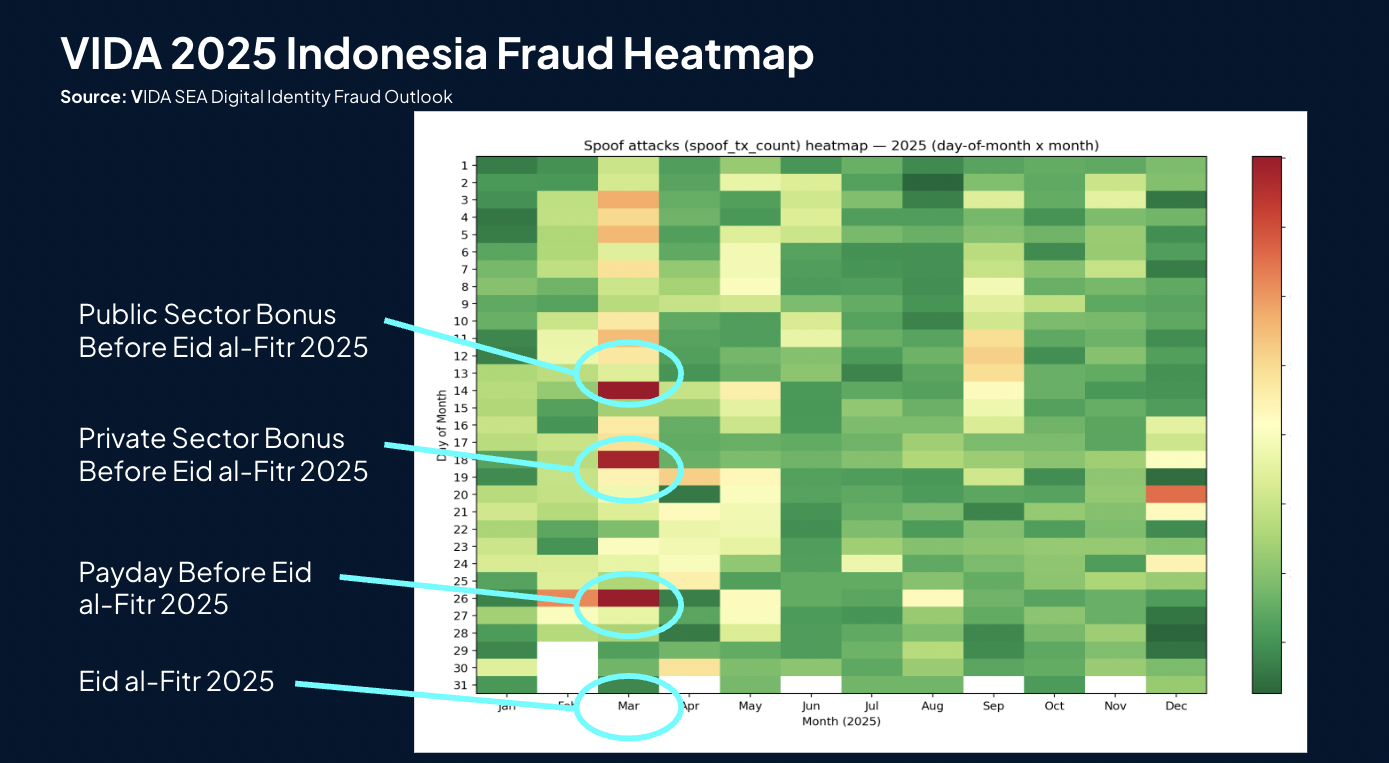
This happens because the tools needed to run FaaS operations are already available and relatively inexpensive. Fraudsters no longer need to build an entire infrastructure from scratch. They can simply activate the tools when needed.
During his keynote at AIBP Malaysia 2026, VIDA Founder and Group CEO Niki Luhur also explained how a fraud attempt that starts with malware can develop into a chain of events that ultimately enables money laundering through crypto assets.
The chain begins when a victim installs a malicious APK. The victim's device can then be remotely controlled, allowing fraudsters to intercept OTPs and use them to drain the victim's bank account. Once the funds are moved to intermediary accounts and converted into crypto, the process can happen within seconds, across borders, making the money difficult to freeze or recover.
What Types of FaaS Tools Are Available on the Dark Web?
The FaaS ecosystem provides a range of tools needed to operate fraud at scale. Many are readily available and do not require advanced technical expertise to use.
Phishing and Social Engineering Kits: Templates for emails, fake websites, and messages that can be customized to impersonate financial institutions or e-commerce platforms. Phishing kits often also come with dashboards for monitoring victims.
Malware and Remote Access Tools (RATs): Software that allows fraudsters to remotely access and control victims' devices. These tools can be used to steal credentials, intercept OTPs, and access sensitive information without the user's knowledge.
Stolen Credential Databases: Databases containing usernames, passwords, and personal information obtained through data breaches.
Document Forgery Tools: Software that uses AI to manipulate or generate fake identities and documents.
API Injection and Infrastructure Tools: Software designed to inject malicious code into application programming interfaces (APIs) or systems, allowing fraudsters to manipulate transaction flows.
Gartner's Predicts 2024: AI & Cybersecurity research noted that toolkits for conducting injection attacks are increasingly available through online platforms, contributing to a 200% increase in these attacks in 2023.
How Does Fraud-as-a-Service Change the Way Businesses Should Assess Identity Verification Risk?
Effective fraud prevention against FaaS is not simply about detecting attacks after they happen. The goal is to increase the complexity and cost fraudsters face when attempting to compromise an account.
A strong fraud detection and prevention strategy should focus on three critical layers that standard FaaS tools cannot easily bypass.
1. Strong Identity Verification
The first layer is strong identity verification, ensuring that the identity being used is genuine and has not been compromised.
When every identity must pass multiple verification checks, including document, biometric, and device verification, FaaS tools designed to operate at scale become significantly less efficient.
2. Device Authentication
The second layer is device authentication, which confirms that interactions come from a legitimate device rather than an emulator or virtual phone commonly used in large-scale FaaS operations.
This layer is particularly important because emulator farms and remote infrastructure are often used to operate fraud at scale.
3. Behavioral Intelligence
The third layer is behavioral intelligence, which analyzes transaction and interaction patterns that deviate from a user's normal profile.
An adaptive fraud detection system can identify suspicious behavior even when fraudsters use legitimate credentials or FaaS tools to bypass traditional security controls.
The combination of these three layers changes the economics of an attack. The cost of compromising an account increases significantly while the success rate decreases.
For FaaS operations, where profitability depends heavily on scale and efficiency, layered fraud prevention can make an operation far less profitable.
Why Fraud Prevention Needs to Evolve
Fraud-as-a-Service has changed the economics of cybercrime. Fraudsters no longer need to develop sophisticated tools themselves. They can access ready-made infrastructure, stolen data, and attack tools as services.
For banks, fintech companies, e-commerce platforms, and other digital businesses, this means fraud prevention can no longer rely on a single point of verification.
A modern fraud detection and prevention strategy needs to verify the identity, device, and behavior behind every digital interaction. By combining these layers, businesses can make it significantly harder and more expensive for fraudsters to scale their operations.
Want to learn more about how VIDA can help strengthen your fraud prevention strategy?
Contact the VIDA sales team: https://vida.id/id/sales