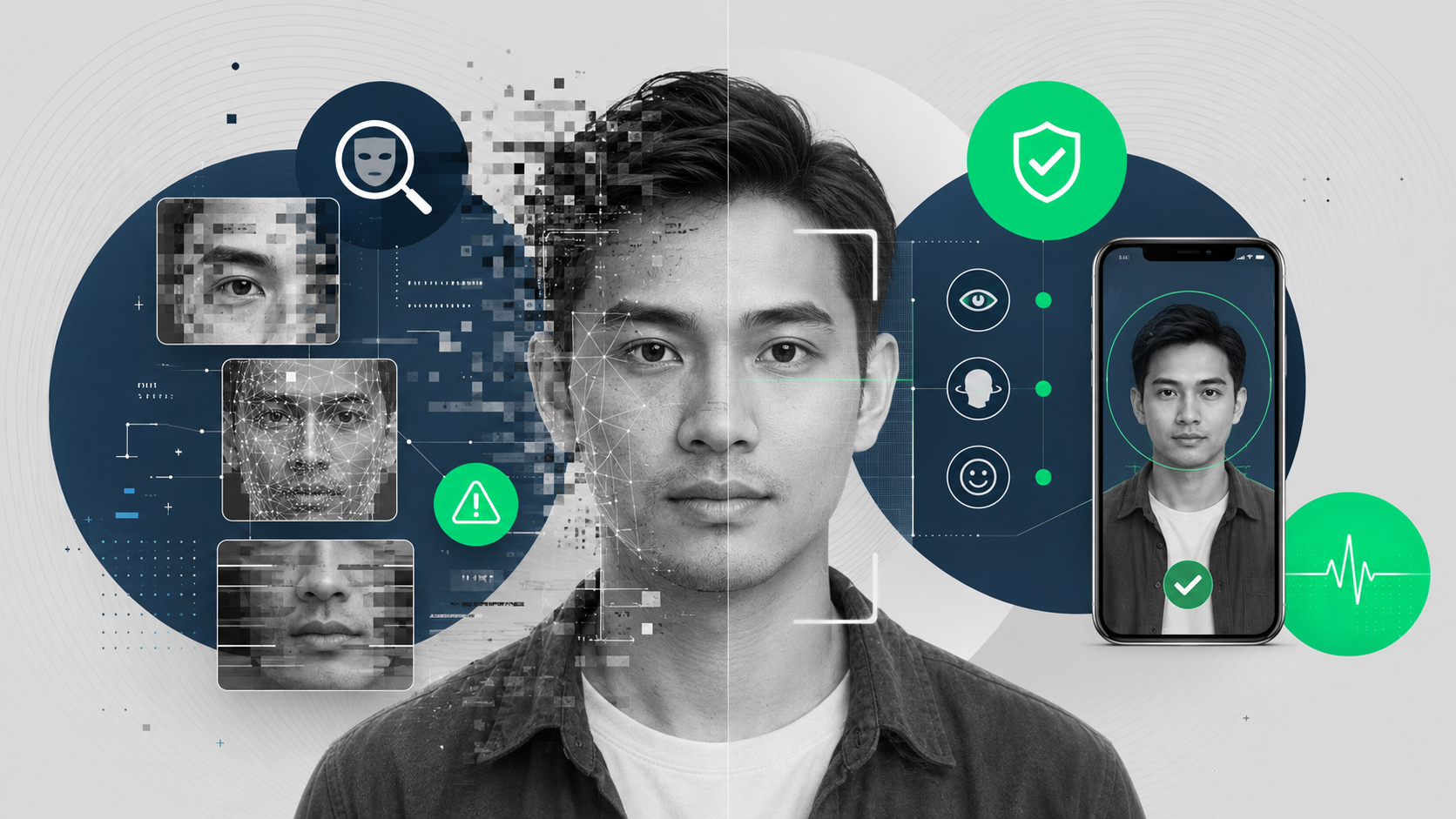
The distinction between deepfake detection vs liveness checks is one that many organizations overlook, often to their detriment. Both technologies defend against identity fraud, but they solve fundamentally different problems. Confusing one for the other, or assuming that deploying one eliminates the need for the other, creates gaps that sophisticated attackers are increasingly prepared to exploit.
As deepfake incidents in Indonesia surged 1,550% between 2022 and 2023, the urgency of getting this distinction right has never been higher. Organizations that understand how these two technologies complement each other build verification systems that are meaningfully harder to defeat. Those that do not leave themselves exposed to attacks that grow more convincing by the month.
What Is Liveness Detection?
Liveness detection is a biometric security technology that verifies whether the person presenting themselves for verification is physically present and alive, rather than a photograph, pre-recorded video, or static image held up to a camera. It answers one specific question: is this a real human being in front of the sensor right now?
Modern liveness detection systems use a range of techniques to make this determination. Active liveness requires users to perform specific actions, such as blinking, turning their head, or following an on-screen prompt. Passive liveness analyzes subtle cues like skin texture, micro-expressions, light reflection patterns, and depth information without requiring any deliberate action from the user.
The core strength of liveness detection is its ability to defeat presentation attacks, where an attacker holds up a printed photo, plays a video on a screen, or uses a 3D mask in front of the camera. According to Gartner, by 2026, 30% of enterprises will consider identity verification solutions unreliable without integrated liveness detection.
What Is Deepfake Detection?
Deepfake detection identifies whether the media being presented, whether a video stream, a selfie image, or an audio clip, has been synthetically generated or digitally manipulated using AI tools. It answers a different question from liveness: is this media authentic, or has it been artificially created?
Deepfake detection systems analyze visual and audio signals for artifacts that indicate AI manipulation. These include inconsistencies in facial geometry, unnatural blending at the edges of face swaps, irregular blinking patterns, lighting anomalies, and compression artifacts that differ from those found in genuine camera captures.
The threat that deepfake detection addresses is qualitatively different from what liveness detection handles. A deepfake is not a photo held up to a camera. It is a synthetically generated face injected directly into the verification pipeline, often at the software level, bypassing the camera entirely. Deepfakes creatable with cheap open-source AI tools have made this attack vector accessible to a far broader range of fraudsters than even two years ago.
How Do Deepfake Detection and Liveness Checks Differ?
The core difference between deepfake detection vs liveness checks lies in what each technology examines and what attack type it is designed to counter. Understanding this difference is critical for building a verification system without blind spots.
What They Examine
Liveness detection focuses on the session itself. It evaluates whether the interaction is happening in real time with a physically present person. It examines behavioral and physiological signals: movement, texture, depth, and response to prompts.
Deepfake detection focuses on the media content. It evaluates whether the image, video, or audio stream has been generated or altered by AI. It examines pixel-level artifacts, metadata anomalies, and statistical patterns that distinguish synthetic media from authentic captures.
What Attacks They Counter
Liveness detection counters presentation attacks: printed photos, screen replays, masks, and other physical spoofing methods. These attacks present real media (an actual photo of the victim) through fake means (holding it up to the camera).
Deepfake detection counters injection attacks: AI-generated face swaps, synthetic selfies, and manipulated video streams fed directly into the verification software. These attacks present fake media (an AI-generated face) through what appears to be a legitimate session.
Where They Fall Short Alone
Liveness detection alone cannot catch a sophisticated deepfake that is injected at the software level, bypassing the camera sensor entirely. The system may confirm that "something live" is happening, but if that "something" is a deepfake video stream injected into the app's camera feed, liveness alone may not flag it.
Deepfake detection alone cannot catch a simple presentation attack where an attacker holds up a genuine, unaltered photo of the victim. The media itself is authentic, not AI-generated, so deepfake detection has nothing to flag. But the person presenting it is not the rightful identity holder.
Why Do You Need Both Deepfake Detection and Liveness Checks?
You need both because attackers choose their method based on whatever defense is weakest. Deploying only one technology creates a predictable gap that can be targeted. The VIDA Indonesia Fraud Report 2025 found that 38.5% of businesses are unsure whether their current systems can detect deepfakes, a figure that suggests many organizations have invested in liveness without addressing the synthetic media threat.
Consider the attack landscape from the attacker's perspective. If a bank deploys liveness detection but not deepfake detection, the attacker switches to injection attacks using synthetic video. If the bank deploys deepfake detection but not liveness, the attacker reverts to holding up a printed photo.
The 97% of Indonesian businesses that faced account takeover attempts in 2024 were targeted by attackers using whichever method offered the path of least resistance. A defense that covers only one attack category is, in practice, only a partial defense.
The combination of both technologies creates what security professionals call defense in depth. Liveness detection confirms physical presence. Deepfake detection confirms media authenticity. Together, they establish that a real person is genuinely present and that the media being captured has not been synthetically generated or tampered with.
How Does VIDA Combine Deepfake Detection and Liveness Checks?
VIDA's approach integrates both technologies into a unified verification platform rather than treating them as separate, sequential steps. This architectural decision has practical consequences for both security effectiveness and user experience.
VIDA's Deepfake Shield runs deepfake detection and liveness checks in parallel within a single SDK. Rather than routing a verification session through one system and then the other, both analyses execute simultaneously on the same biometric capture. This parallel processing means that adding deepfake detection does not increase verification time or add friction for the user.
The platform also incorporates a third defensive layer: device intelligence. VIDA's system detects emulators, rooted phones, VPN connections, and fake GPS coordinates, which are common indicators of injection attacks. By combining biometric analysis with environmental signals, the platform addresses all three fraud vectors identified in modern identity attacks: fake biometrics, fake devices, and fake identities.
Document verification through AI-powered OCR adds further depth. With document forgeries surging 244% year over year and 57% of forgeries now digital according to the VIDA Indonesia Fraud Report 2025, validating the authenticity of submitted identity documents is as critical as validating the person submitting them.
What Should Organizations Consider When Choosing a Solution?
Organizations evaluating deepfake detection vs liveness checks should resist the temptation to choose one over the other. The question is not which technology to deploy, but how to deploy both in a way that is effective, efficient, and compliant.
Integration Architecture
Solutions that treat deepfake detection and liveness as separate modules requiring separate integrations introduce unnecessary complexity and latency. A unified SDK that handles both in parallel reduces development effort and eliminates the gaps that can emerge between loosely coupled systems.
Regulatory Alignment
Indonesia's POJK 12/2024 introduced a four-pillar anti-fraud mandate that reflects growing regulatory expectations around identity verification robustness. Organizations that deploy both deepfake detection and liveness checks are better positioned to meet these requirements than those relying on a single layer.
User Experience Impact
Verification friction directly impacts conversion rates. The 39% increase in onboarding abandonment reported in the VIDA Indonesia Fraud Report 2025 demonstrates the cost of poorly implemented security controls. Solutions that run both analyses in parallel, without adding extra steps for the user, avoid this trade-off between security and usability.
Future Readiness
The quality of deepfakes improves continuously. Detection systems must be regularly updated with new models trained on the latest generation of synthetic media. Organizations should evaluate whether their chosen solution includes ongoing model updates or requires manual intervention to stay current with evolving threats.
The distinction between deepfake detection vs liveness checks matters because attackers do not limit themselves to a single strategy. Building defenses that address both presentation attacks and injection attacks is no longer a best practice. It is a baseline requirement for any organization serious about identity security.
Frequently Asked Questions
What is the main difference between deepfake detection and liveness detection?
Liveness detection verifies that a real, physically present person is in front of the camera. Deepfake detection identifies whether the media being presented has been synthetically generated or manipulated by AI. They counter different attack types and are most effective when used together.
Can liveness detection catch deepfakes?
Basic liveness detection may not catch sophisticated deepfakes, particularly injection attacks where synthetic video is fed directly into the camera software. Advanced liveness systems with injection attack detection offer better protection, but dedicated deepfake detection provides a more reliable defense against AI-generated media.
Do I need both deepfake detection and liveness checks?
Yes. Attackers choose their method based on the weakest available defense. Liveness alone leaves organizations vulnerable to injection attacks using synthetic media. Deepfake detection alone cannot catch simple presentation attacks using genuine photos. Both layers are needed for comprehensive protection.
How does VIDA combine these technologies?
VIDA integrates deepfake detection, liveness checks, and device intelligence into a unified SDK. All three analyses run in parallel during a single verification session, providing comprehensive protection without adding extra steps or friction for the user.
What is an injection attack in biometric verification?
An injection attack bypasses the physical camera by feeding synthetic video or images directly into the verification software at the application or operating system level. This type of attack can defeat liveness detection systems that only monitor camera input, making dedicated deepfake detection essential.
How does regulation influence the choice between these technologies?
Indonesia's POJK 12/2024 anti-fraud mandate reflects a regulatory trend toward requiring robust, multi-layered identity verification. Organizations that deploy both deepfake detection and liveness checks are better aligned with current and anticipated regulatory requirements.
.png)