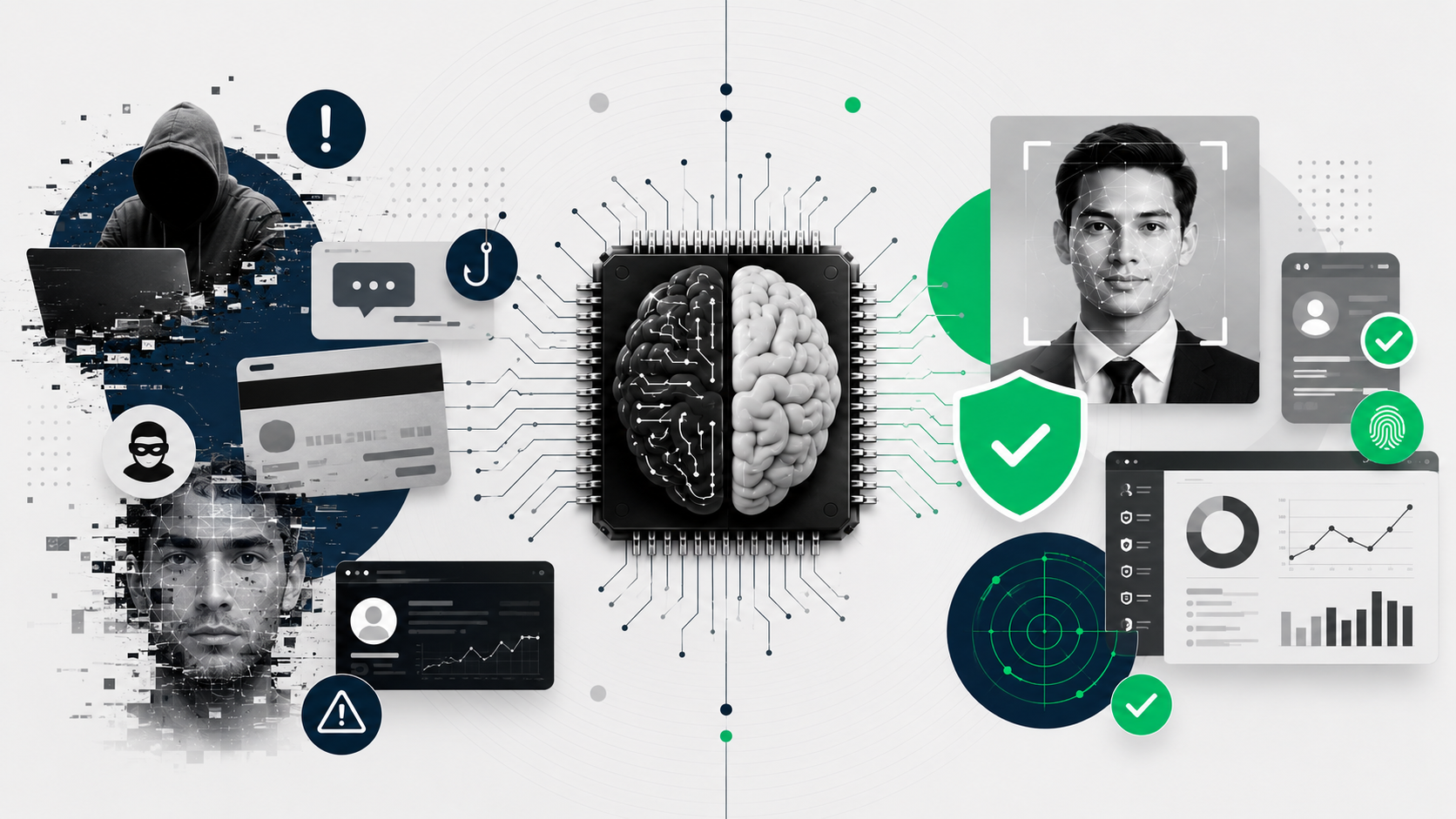
Fraud detection using AI has become the defining battleground of digital security. The same artificial intelligence capabilities that power recommendation engines, language models, and image generators are now being weaponized by fraudsters to create convincing fake identities, forge documents, and impersonate real people in real time. The only viable counter is AI itself, deployed defensively to detect what human reviewers and rule-based systems cannot.
This is the paradox of modern fraud prevention: AI is both the threat and the solution. Understanding how artificial intelligence operates on both sides of this equation is essential for any organization that handles sensitive customer data or financial transactions.
How Are Fraudsters Using AI to Attack?
Deepfakes and Synthetic Media
The most dramatic application of AI in fraud is the creation of deepfakes. These AI-generated images, videos, and audio recordings can convincingly replicate a person's face, voice, and mannerisms. Between 2022 and 2023, deepfake incidents in Indonesia surged by 1,550%. Globally, deepfake-related fraud has grown at roughly 900% annually since 2017.
The barrier to entry has collapsed. Tools that once required specialized hardware and expertise are now available as consumer-grade applications. An attacker can generate a realistic face video in minutes, using it to bypass facial recognition during account onboarding or to impersonate a company executive in a video call. One high-profile case in Hong Kong saw criminals use deepfake technology to orchestrate a $25 million transfer by impersonating multiple executives in a single video conference.
AI-Powered Document Forgery
Document forgery has undergone its own AI-driven transformation. Fraudsters use generative AI to produce identity documents, bank statements, and utility bills that match the formatting, fonts, and security features of genuine documents with alarming accuracy. Indonesia's VIDA Fraud Report 2025 documented a 244% year-over-year increase in document forgeries, driven largely by AI tools that automate the creation process.
The scale is the challenge. When a single operator can produce thousands of forged documents per day, manual review becomes physically impossible. Only automated systems can keep pace.
Synthetic Identity Construction
Perhaps the most insidious AI-driven fraud technique is synthetic identity creation. Rather than stealing an entire identity, attackers use AI to blend real data fragments, a legitimate national ID number here, a fabricated name there, an AI-generated photo on top, into composite identities that pass initial verification checks. These synthetic identities can be nurtured over months, building credit histories and establishing trust before being used for large-scale fraud.
How Does AI Defend Against Fraud?
Machine Learning for Pattern Recognition
At its foundation, fraud detection using AI relies on machine learning models trained on vast datasets of legitimate and fraudulent behavior. These models identify patterns that human analysts would never catch: subtle correlations between transaction timing, device characteristics, geographic signals, and behavioral markers that distinguish genuine users from impostors.
Unlike rule-based systems that flag transactions based on rigid thresholds (transactions over a certain amount, logins from certain countries), machine learning adapts continuously. As fraud patterns evolve, the models retrain on new data, maintaining detection accuracy even as attackers change tactics.
Liveness Detection and Biometric AI
Liveness detection represents one of the most critical applications of AI in fraud prevention. When a user submits a biometric sample during identity verification, liveness detection algorithms analyze whether the sample comes from a live, physically present person or from a reproduction such as a photograph, video replay, or deepfake.
Advanced liveness systems examine micro-level features: skin texture variations, natural eye movement patterns, the way light interacts with three-dimensional facial structure, and involuntary micro-expressions that synthetic media struggles to replicate. These analyses happen in milliseconds, providing real-time fraud prevention without adding noticeable friction to the user experience.
Deepfake Detection AI
Deepfake detection has emerged as a specialized branch of AI fraud prevention. While deepfakes are increasingly convincing to human observers, they leave traces that detection algorithms can identify. These include inconsistencies in facial boundary blending, unnatural eye reflection patterns, temporal artifacts between video frames, and statistical anomalies in pixel-level data.
Gartner predicts that by 2026, 30% of enterprises will consider identity verification solutions inadequate without dedicated deepfake detection capabilities. This projection reflects a growing recognition that standard biometric verification, without AI-powered deepfake shielding, is increasingly vulnerable.
Device Intelligence and Environmental Analysis
AI-powered fraud detection extends beyond the individual to the device and environment from which they interact. Device intelligence systems use machine learning to assess whether an authentication attempt originates from a legitimate device or a spoofed environment.
This includes detecting emulators (software that mimics a real device), identifying VPN usage intended to mask geographic location, flagging fake GPS signals, and recognizing patterns associated with device farms, collections of phones used to automate fraud at scale. These environmental signals, analyzed by AI in real time, add a layer of protection that biometrics alone cannot provide.
Automated Document Verification
AI-driven document verification goes beyond optical character recognition. Modern systems analyze the structural integrity of identity documents, examining security features, watermarks, font consistency, microprinting, and layout patterns. Machine learning models trained on thousands of genuine and forged document samples can detect forgeries that would pass casual inspection.
The speed advantage is decisive. While a human reviewer might spend several minutes examining a single document, an AI system can assess authenticity in seconds, enabling real-time verification during digital onboarding without creating bottlenecks.
Why Is Real-Time AI Fraud Detection Critical?
Fraud happens fast. An attacker who successfully bypasses identity verification during onboarding can drain an account, access credit, or launder funds within hours. Traditional fraud detection approaches that rely on periodic reviews or next-day batch processing arrive too late.
Real-time AI fraud detection operates at the speed of the interaction itself. Every onboarding attempt, every login, every high-risk transaction triggers an instantaneous assessment across multiple fraud vectors. The system does not wait for a human to review a flagged case. It makes a decision, approves, challenges, or blocks, the moment the fraud is attempted.
This immediacy is especially important given the scale of modern fraud operations. With 97% of businesses facing account takeover attempts in 2024 and 23% of Indonesian consumers reporting financial losses to scams, the volume of attacks overwhelms any system that depends on human intervention as a primary defense.
What Role Does Regulation Play in AI Fraud Detection?
Regulatory frameworks are catching up to technological reality. Indonesia's POJK 12/2024 established a four-pillar anti-fraud framework that requires financial institutions to implement proactive, technology-driven fraud prevention rather than relying solely on reactive measures. Similar regulatory movements are underway across Southeast Asia and globally.
For organizations building or selecting fraud detection systems, regulatory compliance serves as a baseline. The technology must meet minimum standards, but the threat environment often demands capabilities that exceed what regulations explicitly require. Organizations that build only to the regulatory floor frequently find themselves exposed when new attack vectors emerge.
How Does VIDA Apply AI to Fraud Detection?
VIDA's approach to fraud detection using AI addresses all three primary fraud vectors, fake biometrics, fake devices, and fake identities, through an integrated platform rather than disconnected point solutions.
Deepfake Shield applies specialized AI to detect synthetic facial media in real time, neutralizing deepfake attacks before they reach the verification pipeline. Liveness detection confirms physical presence, while face matching validates the person against their verified identity document.
ID Fraud Shield brings device intelligence into the assessment, using AI to detect emulators, VPN masking, fake GPS, and other environmental indicators of fraudulent intent. Document verification with advanced analysis catches the AI-generated forgeries that basic OCR systems miss.
The platform's unified SDK runs these checks in parallel through automated fraud detection, assessing biometric, device, and document signals simultaneously rather than sequentially. This parallel architecture reduces both the time required for verification and the gaps between sequential checks that sophisticated attackers exploit.
For organizations navigating the dual reality of AI as both threat and defense, the path forward requires comprehensive solutions that match the sophistication of the attacks they face. Fraud detection using AI is not a single technology. It is an integrated discipline that must evolve as fast as the threats it counters.
Frequently Asked Questions
How does AI detect fraud in real time?
AI fraud detection uses machine learning models that analyze multiple signals simultaneously, including biometric data, device characteristics, document integrity, and behavioral patterns, to make instant approve-or-block decisions during each interaction.
Can AI detect deepfakes?
Yes. Specialized deepfake detection AI identifies artifacts in synthetic media that human observers typically miss, including facial boundary inconsistencies, unnatural eye reflections, temporal anomalies between frames, and pixel-level statistical irregularities.
What is the difference between rule-based and AI-based fraud detection?
Rule-based systems flag activity based on fixed thresholds and predefined criteria. AI-based systems learn from data patterns and adapt continuously, detecting novel fraud techniques that would not trigger static rules.
Why do fraudsters use AI?
AI dramatically reduces the cost and time required to create convincing fake identities, forge documents, and generate deepfakes. Tools that once required specialized expertise are now accessible to anyone, enabling fraud at industrial scale.
What is device intelligence in fraud detection?
Device intelligence uses AI to analyze the technical environment of an authentication attempt, detecting emulators, VPN usage, fake GPS signals, and device farm patterns that indicate the request originates from a fraudulent source.
Sources
- VIDA, Indonesia Fraud Report 2025
- VIDA, What The Fake! Deepfake Report
- Gartner, Predictions for Identity Verification and Deepfakes, 2026
- OJK, POJK 12/2024 Anti-Fraud Framework
.png)