Not long ago, proving identity meant handing over a plastic card or reciting a memorized password. Banks asked for PINs, airports checked paper documents against a printed photo, and online platforms relied on knowledge-based questions that a quick social media search could answer. The system worked until it didn't.
Today, the question of what is biometric authentication has become central to how businesses secure digital transactions. Biometric authentication uses measurable biological characteristics: a fingerprint, a face, an iris pattern, or even a voice to confirm that a person is who they claim to be. It replaces something a user knows (a password) or has (a token) with something a user is, making identity far harder to forge.
How Does Biometric Authentication Work?
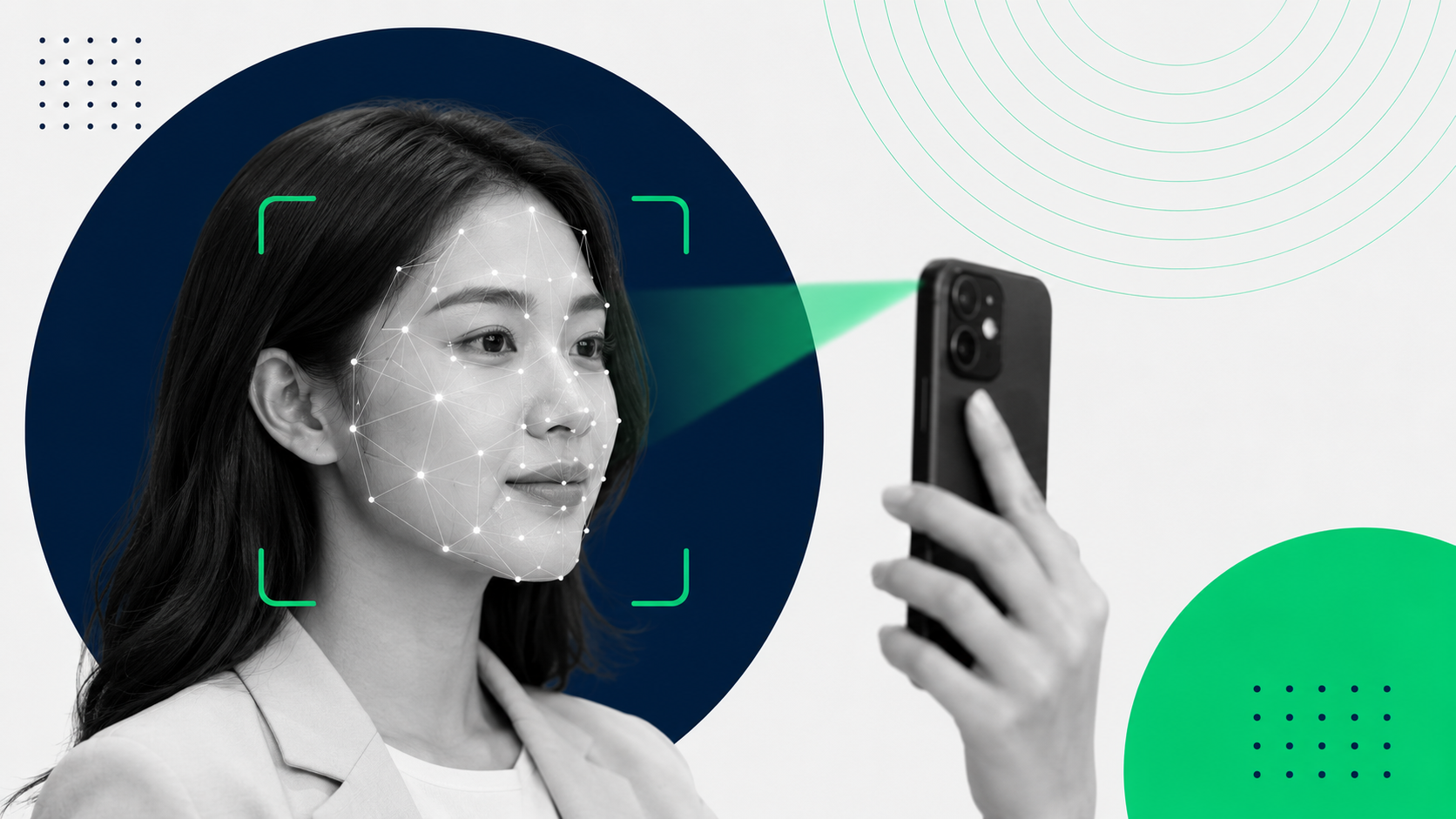
Biometric authentication captures a unique biological trait, converts it into a digital template, and compares it against a stored reference. When a customer places a finger on a sensor or looks into a camera, the system extracts distinctive data points, ridge patterns on a fingertip, the distance between facial landmarks and runs a match.
The process unfolds in three stages. Enrollment records the initial biometric sample. Storage secures the resulting template, typically encrypted rather than stored as a raw image. Verification compares a live sample against the stored template each time access is requested.
What separates modern biometric systems from earlier versions is speed and precision. A well-engineered liveness detection layer can confirm a live human presence in under a second, blocking photos, masks, and screen replays before they reach the matching engine.
What Are the Main Biometric Authentication Methods?
Biometric authentication methods fall into two broad categories: physiological traits that measure the body, and behavioral traits that measure patterns of action. Most commercial deployments focus on physiological methods because they offer higher consistency across sessions.
Fingerprint Recognition
Fingerprint recognition remains the most widely deployed biometric modality worldwide. Sensors map the ridges, whorls, and minutiae of a fingertip, producing a template that is statistically unique across billions of people.
Consumer devices popularized the technology, but enterprise and government systems rely on it for everything from border control to employee access. Its main limitation is environmental wet, damaged, or aged skin can reduce accuracy, which is why many organizations pair fingerprint recognition with a second factor.
Facial Recognition
Facial recognition has become the dominant biometric method for remote onboarding and mobile-first transactions. A front-facing camera captures a face, and algorithms map geometry: the jawline, the spacing of eyes, the depth of the nose bridge.
The appeal is obvious: no specialized hardware beyond a standard smartphone camera. But the risk is equally clear. Deepfake incidents in Indonesia surged 1,550% between 2022 and 2023, demonstrating that a static facial image alone is no longer sufficient proof of identity. Organizations need deepfake detection layered on top of facial recognition to stay ahead of synthetic media attacks.
Iris and Voice Recognition
Iris scanning offers extremely high uniqueness; the probability of two irises matching is estimated at less than one in a trillion. However, it requires specialized near-infrared cameras, limiting its use to high-security physical environments.
Voice recognition analyzes vocal patterns, pitch, cadence, and frequency. It works well for phone-based authentication but remains vulnerable to recorded playback and, increasingly, AI-generated voice clones.
Why Is Liveness Detection Critical for Biometric Security?
Without liveness detection, biometric systems are vulnerable to presentation attacks — where a fraudster holds up a photo, a video, or a 3D mask to impersonate a legitimate user. Liveness detection solves this by confirming that the biometric sample comes from a living, physically present person rather than a reproduction.
Gartner predicts that by 2026, 30% of enterprises will consider identity verification solutions unreliable without liveness detection built in. The prediction reflects a market reality: attackers have moved beyond crude spoofing attempts into sophisticated deepfake territory, and static matching alone cannot keep pace.
Modern liveness detection operates in two modes. Active liveness asks the user to perform an action blinking, turning the head, smiling. Passive liveness analyzes texture, light reflection, and depth cues without requiring user interaction, which reduces friction and improves completion rates.
The most resilient systems combine both approaches. VIDA's single SDK, for instance, runs liveness detection and device intelligence in parallel, catching not just fake biometrics but also fake devices and fake identities in a single verification flow.
How Does Biometric Authentication Fit Into Multi Factor Authentication?
Multi-factor authentication strengthens security by requiring two or more independent credentials. Biometrics serve as the "something you are" factor, complementing "something you know" (a password or PIN) and "something you have" (a phone or hardware token).
Adding biometrics to a multi-factor authentication framework dramatically reduces account takeover risk. In Indonesia, 97% of businesses faced account takeover attempts in 2024, according to the VIDA Indonesia Fraud Report 2025. Many of those attacks exploited single-factor defenses: a stolen password, a hijacked SMS code that biometrics would have blocked.
The strongest implementations bind the biometric factor to a specific device. A face scan authenticated on a registered smartphone, verified against a stored template and confirmed by device-level signals, creates a chain of trust that is exceptionally difficult to replicate remotely.
What Threats Do Biometric Systems Face?
Biometric authentication is not immune to attack. Understanding the threat landscape helps organizations choose the right defenses.
Fake Biometrics
Presentation attacks use photos, videos, silicone fingerprints, or AI-generated deepfakes to fool sensors. As synthetic media tools become more accessible, 38.5% of organizations report being unsure whether their current systems can even detect deepfakes. This uncertainty is a vulnerability in itself attackers exploit gaps where confidence is low.
Fake Devices
Emulators and rooted devices can bypass client-side security checks, feeding manipulated biometric data directly to the verification API. Device intelligence tools counter this by fingerprinting the hardware and software environment before any biometric capture begins.
Fake Identities
Synthetic identity fraud combines real and fabricated data — a genuine ID number paired with a generated face — to create identities that pass superficial checks. Catching these requires cross-referencing biometric data against document verification and authoritative identity databases.
Addressing all three vectors simultaneously is what separates enterprise-grade solutions from consumer-level tools. VIDA's approach — combining liveness detection, deepfake detection through its Deepfake Shield, device intelligence, and document OCR in a unified identity platform — reflects this layered defense philosophy.
Where Is Biometric Authentication Headed?
The trajectory is clear: biometric authentication is moving from a supplementary security layer to the primary trust anchor for digital identity. Several forces are accelerating this shift.
Regulatory frameworks are catching up. In Indonesia, Certification Authority (CA) providers like VIDA operate under Komdigi oversight, ensuring that biometric data handling meets national standards for privacy and security. Similar regulatory structures are emerging across Southeast Asia.
Behavioral biometrics keystroke dynamics, gait analysis, touchscreen pressure are beginning to supplement physiological methods, enabling continuous authentication rather than one-time gate checks. A user verified at login can be silently re-verified throughout a session based on how they interact with their device.
On-device processing is reducing privacy concerns by keeping biometric templates on the user's hardware rather than transmitting them to centralized servers. This architecture aligns with data minimization principles and reduces the blast radius of potential breaches.
For businesses evaluating identity verification solutions, the question is no longer whether to adopt biometric authentication but how deeply to integrate it and whether the chosen solution can defend against the next generation of attacks. Understanding what biometric authentication is at a fundamental level is the first step toward making that decision well.
Frequently Asked Questions
What is biometric authentication and how is it different from passwords?
Biometric authentication verifies identity using unique biological traits like fingerprints or facial features, rather than memorized credentials. Unlike passwords, biometrics cannot be forgotten, shared, or easily stolen through phishing attacks. They tie access directly to the individual's physical presence.
Which biometric authentication methods are most secure?
Iris recognition offers the highest statistical uniqueness, but facial recognition combined with liveness detection provides the best balance of security and usability for remote digital transactions. Multi-modal approaches using two or more biometric methods together deliver the strongest protection.
Can biometric authentication be fooled by deepfakes?
Without proper defenses, yes. Deepfake attacks have surged dramatically, and 38.5% of organizations remain uncertain whether their systems can detect them. Effective biometric platforms counter this with dedicated deepfake detection and passive liveness analysis that identify synthetic media in real time.
How does liveness detection prevent biometric fraud?
Liveness detection confirms that a biometric sample comes from a real, physically present person, not a photo, video, or 3D mask. It analyzes texture, depth, light reflection, and micro-movements to distinguish genuine faces from reproductions. Gartner expects 30% of enterprises to require it by 2026.
Is biometric data safe from breaches?
Modern systems store encrypted mathematical templates rather than raw images, making stolen data difficult to reverse-engineer. On-device processing further reduces risk by keeping biometric templates on the user's hardware. Choosing a provider with regulatory oversight such as a PSrE-licensed platform adds another layer of accountability.
Why do businesses need multi-factor authentication with biometrics?
Biometrics alone address the "something you are" factor, but combining them with device-based signals and knowledge factors creates defense in depth. With 97% of Indonesian businesses facing account takeover attempts in 2024, single-factor security of any kind including biometrics alone is insufficient against determined attackers.
Sources
- VIDA Indonesia Fraud Report 2025 — Account takeover statistics and deepfake incident data for Indonesian businesses.
- Gartner Identity Verification Predictions —Forecast on enterprise adoption of liveness detection by 2026.
- Pactvera Digital Identity Report — Analysis of synthetic identity fraud trends and biometric attack vectors.
- VIDA Solutions Overview — Liveness detection, Deepfake Shield, document verification, and identity platform capabilities.
.png)