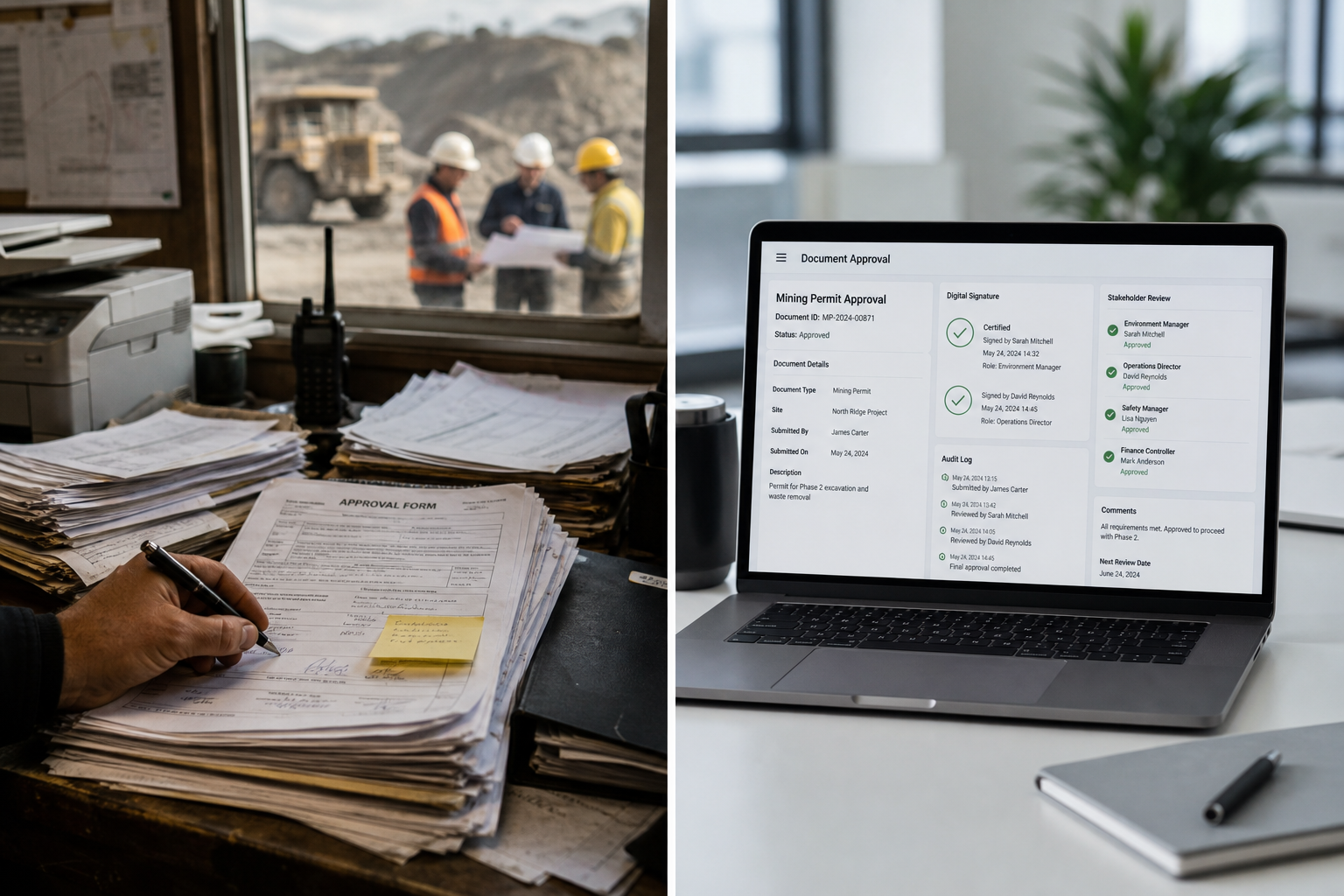
Mining operations often involve teams working across remote sites, contractors, and headquarters. When mining permit documentation and other operational records require review and signatures, the approval process can become difficult to manage if documents still depend on physical movement.
The difference between conventional and digital approval workflows is not only about how a signature is added to a document. It also affects how quickly documents can move between stakeholders, how approval activities are tracked, and how records are maintained after signing.
Read More: Is a Scanned Signature on a PDF Legally Valid?
Why Mining Permit Documentation Needs a Reliable Approval Workflow
Mining permit documentation can involve multiple stakeholders, including site teams, contractors, supervisors, and management at headquarters. Depending on the type of work and company procedures, supporting documents may need to be reviewed and approved before activities can proceed.
This can include permit-related records, safety documentation, contractor documents, BAST, or other operational records that require authorization.
The challenge becomes more apparent when the person responsible for approving a document is not at the same location as the team preparing it. With a conventional workflow, documents may need to be printed, signed, scanned, sent back, and manually followed up.
For remote mining operations, this creates an additional dependency on physical document handling and the availability of authorized signers.
A digital approval workflow changes how these documents move. Instead of relying on physical document circulation, authorized parties can review and sign documents digitally, while the approval history can be retained as part of the digital record.
Conventional vs. Digital Approval Workflows
The main difference between the two approaches lies in how documents are processed and tracked.
Conventional approval workflow
A conventional workflow typically requires documents to be prepared, printed, and physically signed. If the signer is located elsewhere, the document may need to be transported or sent through several additional steps before the approval is complete.
This can make document status harder to monitor, particularly when multiple documents are being processed at the same time.
Conventional signatures also provide limited visibility into the history of the signing process. Once a physical document has been signed, teams may need separate processes to track when it was approved, who handled it, and where the document is stored.
Digital approval workflow
With a certified digital signature, documents can be reviewed and signed digitally without requiring the signer to handle a physical copy.
The workflow can also provide a more structured record of the approval process. For example, VIDA Sign includes an audit log that records document history, helping teams track activities associated with signed documents. The platform also supports templates, bulk signing, e-Meterai integration, and API integration.
This becomes particularly useful when the same type of documentation needs to be processed repeatedly across different projects, sites, or contractors.
What Changes When Approval Moves from Paper to Digital?
The value of a digital workflow is not simply that a signature can be added remotely. It is the combination of signing, tracking, and document management in one process.
For mining teams, several areas can make a practical difference.
Less reliance on physical document movement
Documents no longer need to travel between a remote site and headquarters simply because an authorized person needs to sign them. This can reduce the manual steps involved in getting a document from preparation to approval.
Better visibility into document history
An audit log can provide a record of document activity, making it easier to trace the approval process and retrieve information when needed.
More efficient handling of recurring documents
Mining operations may process similar documentation repeatedly. Templates can standardize recurring documents, while bulk signing can reduce repetitive signing tasks.
With VIDA Sign, digital signing can help businesses process documents up to 30% faster, improve efficiency by up to 80%, and reduce costs by up to 56% compared with manual processes. These figures are based on VIDA's stated platform benefits.
When to Consider Digital Approval for Mining Documentation
A digital workflow can be particularly relevant when document approval involves one or more of the following conditions:
- Remote operations: The team preparing documents and the authorized signer are working from different locations.
- Multiple stakeholders: Documents need approval from several people across site and headquarters.
- Recurring documentation: Similar documents are processed regularly and can benefit from templates or bulk signing.
- Audit requirements: Teams need a clear record of document activity and signing history.
- Time-sensitive operations: Delays in document approval can affect when related work or administrative processes can proceed.
The goal is not to remove the review or approval process. Instead, digital signing can help remove unnecessary friction from the way documents reach the people responsible for approving them.
Managing Mining Permit Documentation with VIDA Sign
VIDA Sign provides a certified digital signing platform for businesses that need to manage document approvals digitally. Its features include certified digital signatures, audit logs, templates, bulk signing, bulk upload, e-Meterai, and Open API integration.
For mining operations, these capabilities can support different parts of the documentation workflow. A site team can prepare and submit documents digitally, authorized stakeholders can review and sign them remotely, and the resulting records can be tracked through the platform.
For recurring processes, VIDA Sign also supports bulk upload and bulk signing of up to 10 documents at a time, which can help reduce repetitive manual steps when multiple documents require signatures.
This makes digital signing relevant not only for individual permit-related documents, but also for broader operational documentation such as BAST, contractor documents, safety documentation, and other records that require authorization.
Read More: Authorized Representative Signatures: Secure and Proper Examples
Ultimately, choosing between conventional and digital approval workflows is about more than replacing a handwritten signature. For mining companies operating across remote sites, the right workflow can help documents move more efficiently between teams while providing a clearer record of the approval process.
.png)