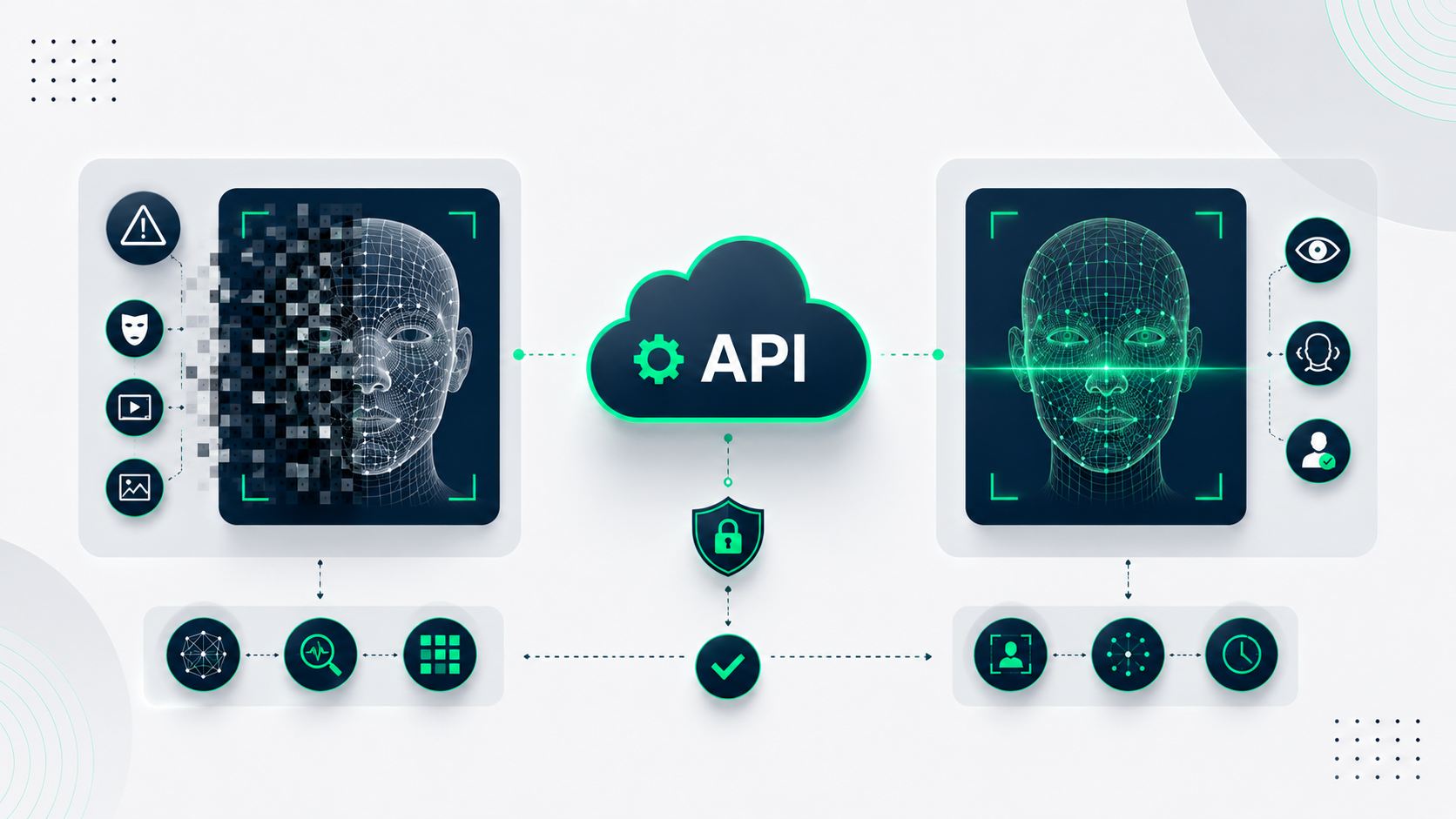
Integrating a deepfake detection API for KYC is no longer a forward-looking initiative. It is a present-day requirement for any platform that onboards users through digital identity verification. The fraud landscape has shifted so dramatically that KYC workflows without deepfake detection are, in practical terms, incomplete.
The numbers make the case clearly. Deepfake incidents in Indonesia surged 1,550% between 2022 and 2023, while document forgeries grew 244% year over year. The VIDA Indonesia Fraud Report 2025 found that 97% of Indonesian businesses experienced account takeover attempts in 2024. For platforms running digital onboarding, these statistics translate into a direct operational question: can your KYC pipeline detect a synthetically generated face?
Why Does KYC Need a Deepfake Detection API?
KYC needs a deepfake detection API because the attack surface for digital identity verification has expanded beyond what traditional checks can handle. Standard KYC flows typically involve document upload, selfie capture, and face matching. Each of these steps is now vulnerable to AI-generated fraud.
Attackers submit synthetically generated selfies that pass basic face matching. They upload digitally forged identity documents that defeat OCR-based extraction. They use device emulators to simulate legitimate mobile environments. According to the VIDA Indonesia Fraud Report 2025, 57% of document forgeries are now digital, and 38.5% of businesses are unsure whether their systems can detect deepfakes.
A dedicated deepfake detection layer within the KYC pipeline catches synthetic media that document verification and face matching cannot. It analyzes the biometric capture for AI manipulation artifacts before the identity is approved, stopping fraudulent onboarding at the point of entry rather than discovering it after damage has been done.
What Should a Deepfake Detection API Include?
A robust deepfake detection API for KYC should cover multiple fraud vectors rather than addressing synthetic biometrics alone. The most effective APIs bundle several capabilities into a unified integration point.
Liveness Detection
The API should verify that a real, physically present person is performing the biometric capture. This defeats presentation attacks where an attacker holds up a photo or plays a video. Gartner projects that by 2026, 30% of enterprises will consider identity verification unreliable without liveness detection. Any API that offers deepfake detection without liveness leaves a fundamental gap.
Injection Attack Detection
Beyond camera-level liveness, the API should detect injection attacks where synthetic video is fed directly into the application at the software level, bypassing the camera entirely. This requires analysis at the application and OS layer, not just the media layer.
Device Intelligence
The API should evaluate the device environment for indicators of fraud: emulators, rooted or jailbroken phones, VPN connections, and spoofed GPS coordinates. These signals correlate strongly with fraudulent verification attempts and provide context that pure media analysis cannot.
Document Verification
AI-powered OCR that validates submitted identity documents against known templates and detects signs of digital manipulation. With document forgeries growing 244% year over year, this layer is essential for comprehensive KYC protection.
How Does a Deepfake Detection API Fit into a KYC Workflow?
A well-designed deepfake detection API integrates into the existing KYC workflow rather than requiring a parallel process. The typical integration flow follows these steps.
The user initiates onboarding and is prompted to capture or upload an identity document. The document image is sent to the API for OCR extraction and forgery detection. The user then performs a selfie capture. The biometric image is analyzed simultaneously for liveness, deepfake artifacts, and face matching against the document photo. In parallel, the API evaluates device signals for emulators, root access, VPN use, and location spoofing.
All of these analyses return results through a single API response, providing the platform with a unified verification decision rather than requiring the developer to orchestrate multiple services and reconcile their outputs.
The critical architectural advantage of this approach is that it runs these checks in parallel rather than sequentially. Sequential processing adds latency at each step, increasing the total verification time and contributing to the onboarding abandonment that 39% of businesses reported in the VIDA Indonesia Fraud Report 2025. Parallel processing keeps the user experience fast while applying comprehensive security analysis behind the scenes.
What Are the Technical Requirements for Integration?
Developers evaluating a deepfake detection API for KYC should assess several technical dimensions beyond the detection capabilities themselves.
SDK vs REST API
Most enterprise-grade solutions offer both a native SDK for mobile integration and a REST API for server-side processing. The SDK approach is preferred for mobile-first KYC flows because it captures device signals and controls the camera capture environment directly. A REST API is better suited for web-based flows or batch processing of previously captured media.
Latency and Throughput
KYC verification happens during user onboarding, a moment when every second of delay increases the risk of abandonment. The API should return results within seconds, not minutes. Evaluate the provider's published latency benchmarks and test under realistic conditions with your expected traffic patterns.
Platform Coverage
The API must support the platforms where your users are onboard. At minimum, this means Android and iOS native SDKs with consistent behavior across device manufacturers. Web SDK support extends coverage to desktop and browser-based flows.
Data Handling and Privacy
Identity verification involves sensitive biometric and document data. The API provider's data handling practices must align with applicable regulations. Evaluate where biometric data is processed, whether it is stored or discarded after verification, and what certifications the provider holds.
Error Handling and Fallbacks
No detection system achieves 100% accuracy. The API should provide confidence scores and detailed result codes that allow the platform to implement appropriate fallback flows, such as manual review for borderline cases, rather than making binary accept-or-reject decisions on ambiguous inputs.
How Does VIDA's API Address These Requirements?
VIDA's identity verification platform is built as a unified API that addresses all the requirements outlined above through a single integration point. As a PSrE (Penyelenggara Sertifikasi Elektronik) licensed by Indonesia's Kominfo, VIDA operates under regulatory oversight that adds a layer of institutional accountability to its technical capabilities.
VIDA's unified SDK runs liveness detection, deepfake detection through its Deepfake Shield, device intelligence through ID Fraud Shield, and document verification in parallel. Developers integrate once and gain access to all four verification layers without managing multiple vendor relationships or reconciling results from disparate systems.
The device intelligence layer specifically detects emulators, rooted phones, VPN connections, and fake GPS, addressing the "fake device" vector that many competing APIs overlook. Phone Token and Face Token provide additional authentication factors that tie verification to a specific device and biometric, making session hijacking and credential theft significantly harder.
For organizations that require digital signatures as part of their onboarding or transactional workflows, VIDA Sign integrates with the same platform, enabling end-to-end identity verification and document signing through a single vendor.
What Questions Should Buyers Ask When Evaluating APIs?
Procurement teams and technical leads evaluating a deepfake detection API for KYC should structure their assessment around several key questions.
First, does the API detect both presentation attacks and injection attacks? Many solutions handle one but not the other. As discussed, both vectors are actively exploited, and a solution that covers only one leaves a predictable gap.
Second, is device intelligence included or does it require a separate integration? Fraud signals from the device environment provide critical context for biometric analysis. Solutions that separate these capabilities force developers to build their own correlation logic.
Third, how frequently are detection models updated? Deepfake technology evolves rapidly. An API whose models were trained six months ago may already miss the latest generation of synthetic faces. Providers should demonstrate a regular model update cadence.
Fourth, what are the provider's regulatory credentials? In regulated industries like financial services, the API provider's licensing and compliance status directly affects the platform's own regulatory posture. VIDA's PSrE license from Kominfo and alignment with POJK 12/2024's four-pillar anti-fraud mandate provide a regulatory foundation that unlicensed providers cannot offer.
Fifth, what does the pricing model look like at scale? KYC verification volumes can be unpredictable, especially during growth phases or marketing campaigns. Evaluate whether pricing scales linearly or whether volume commitments introduce risk.
What Is the Business Case for a Deepfake Detection KYC API?
The business case rests on three pillars: fraud reduction, regulatory compliance, and conversion optimization.
Fraud reduction is the most direct benefit. Every synthetically generated identity that passes KYC becomes a vector for downstream losses: money laundering, account takeover, mule activity, and reputational damage. The 23% of consumers who lost money to scams in 2024 represent not just individual losses but erosion of trust in the platforms where those scams originated.
Regulatory compliance is increasingly non-negotiable. POJK 12/2024's four-pillar anti-fraud mandate signals the direction of regulatory expectations in Indonesia and across Southeast Asia. Platforms that integrate deepfake detection now avoid the scramble of retrofitting compliance under deadline pressure.
Conversion optimization is the less obvious but equally significant benefit. The 39% increase in onboarding abandonment reported by businesses reflects the cost of friction-heavy verification flows. A well-integrated API that runs comprehensive checks in parallel, without adding extra steps for the user, protects conversion rates while strengthening security.
A deepfake detection API for KYC is the infrastructure layer that makes all three outcomes achievable simultaneously. For developers and buyers evaluating their options, the decision is less about whether to integrate this capability and more about choosing a provider whose technical depth, regulatory standing, and integration model match the platform's needs.
Frequently Asked Questions
What is a deepfake detection API for KYC?
A deepfake detection API for KYC is a software interface that analyzes biometric captures during identity verification to determine whether the media has been synthetically generated or manipulated by AI. It integrates into digital onboarding flows to catch fraudulent identities before they are approved.
How does a deepfake detection API differ from standard face matching?
Standard face matching compares a selfie against a document photo to confirm they depict the same person. It does not assess whether the selfie itself is genuine or AI-generated. A deepfake detection API adds that layer, verifying the authenticity of the biometric media itself.
Can a deepfake detection API work with existing KYC systems?
Yes. Most enterprise-grade APIs are designed to integrate into existing verification workflows via SDK or REST API. The best solutions consolidate deepfake detection, liveness, device intelligence, and document verification into a single integration point to minimize development effort.
What industries benefit most from this technology?
Financial services, fintech, insurance, telecommunications, and any platform that performs digital identity verification during onboarding. Industries subject to KYC/AML regulations benefit most directly, but any business with a digital identity verification flow faces exposure to synthetic identity fraud.
How fast is the verification process with deepfake detection added?
With parallel processing architectures, adding deepfake detection does not significantly increase verification time. Solutions like VIDA's unified SDK run liveness, deepfake detection, and device intelligence simultaneously, typically completing all checks within seconds.
Is VIDA's API compliant with Indonesian regulations?
VIDA is a PSrE licensed by Indonesia's Kominfo and is aligned with POJK 12/2024's four-pillar anti-fraud mandate. This regulatory standing provides a compliance foundation for platforms operating in Indonesia's financial services sector.
.png)