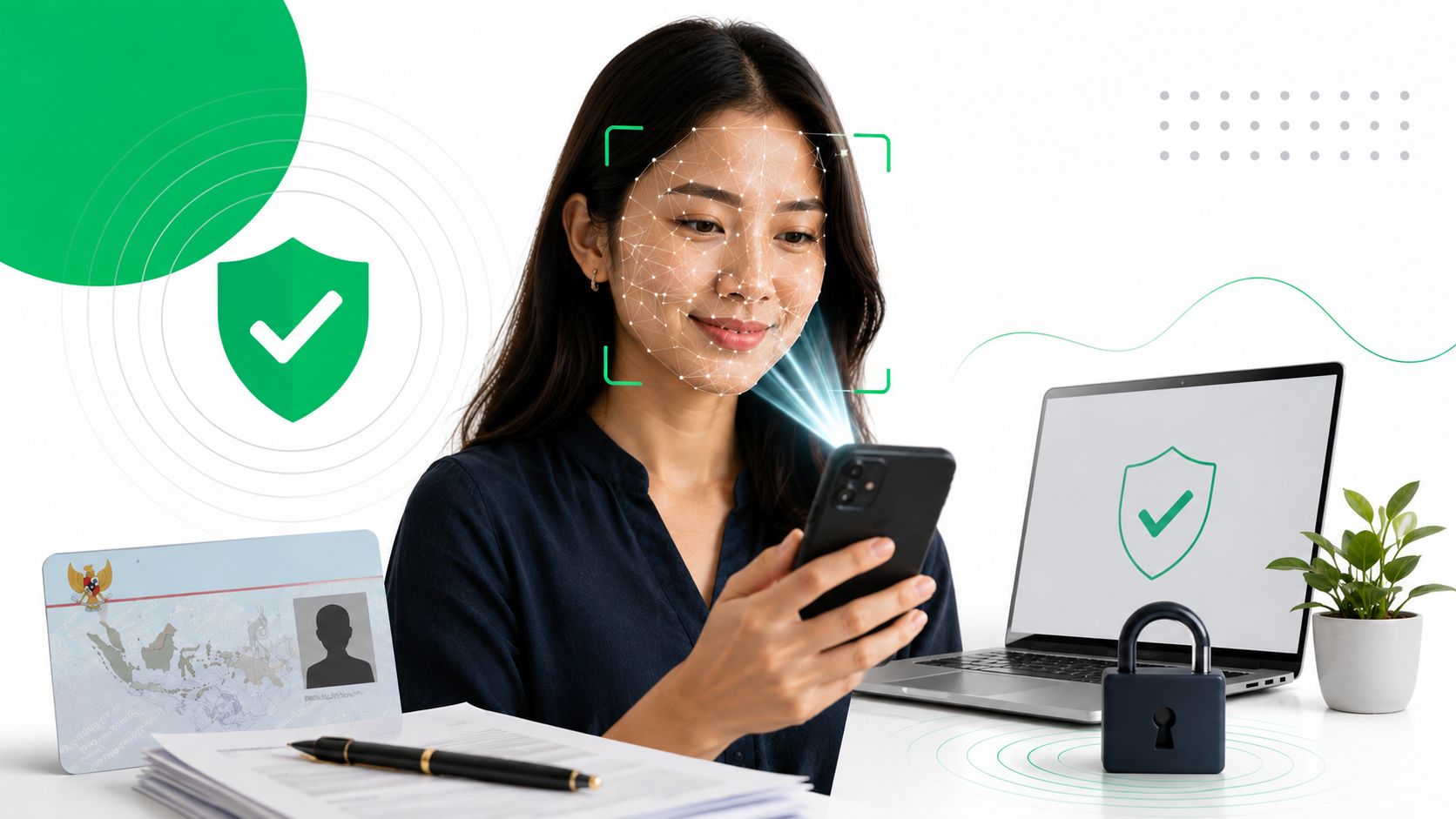
eKYC (electronic Know Your Customer) financial compliance refers to the use of digital identity verification technology to meet regulatory obligations such as anti-money laundering (AML), customer due diligence (CDD), and data protection requirements. Unlike manual KYC processes that rely on physical documents and in-person verification, eKYC automates identity checks through biometric matching, document OCR, and real-time database validation — enabling financial institutions to satisfy compliance mandates faster and more accurately.
The pressure to adopt these systems is mounting. Document forgeries surged 244% year-over-year, with 57% of those forgeries now occurring through digital channels. At the same time, 97% of Indonesian businesses faced account takeover attempts in 2024, exposing the limits of legacy verification methods. For financial institutions balancing regulatory obligations with customer experience, eKYC financial compliance has become a strategic imperative rather than a technology upgrade.
What Is the Difference Between eKYC and Traditional KYC?
Traditional KYC verification was built for a branch-based world. A customer walked in, presented a government-issued ID, and a bank officer manually compared the photo to the person standing across the counter. The process served its purpose for decades, but it was slow, inconsistent, and nearly impossible to scale across digital channels.
eKYC replaces that model with technology-driven verification. Document OCR extracts and validates data from identity cards or passports. Facial biometric authentication matches the person to their document. Liveness detection confirms the biometric sample comes from a live human, not a photograph or deepfake. The entire workflow can complete on a smartphone in minutes, from anywhere.
The global KYC market reflects the scale of this transition: valued at $6.73 billion in 2025, it is projected to reach $14.39 billion by 2030. Financial institutions are not just experimenting with digital verification they are committing to it.
The compliance advantage of eKYC over manual processes comes down to one word: consistency. Digital systems produce structured, auditable, tamper-resistant records every time. Manual processes depend on human judgment that varies from officer to officer and branch to branch a gap regulators increasingly refuse to tolerate.
How Does eKYC Map to KYC, AML, and Data Protection Requirements?
Well-designed eKYC platforms do not treat compliance obligations as separate silos. Instead, a single digital verification workflow can satisfy KYC compliance, AML compliance, and personal data protection requirements simultaneously. KYC automation reduces operational costs by 40-70% compared to manual compliance workflows, but the real value lies in regulatory alignment, not just efficiency.
KYC compliance requires financial institutions to confirm that customers are who they claim to be. eKYC platforms handle this through layered verification: document extraction and validation, facial biometric matching, and liveness detection. Each step generates a timestamped digital record exactly the kind of documentation regulators expect during audits.
AML compliance extends beyond identity. Under Indonesia's UU No. 8/2010 on anti-money laundering, financial institutions must implement customer due diligence, monitor transactions, and report suspicious activity. eKYC addresses the first pillar by establishing verified identities at onboarding. When identity is confirmed before account access is granted, the risk of fraudulent accounts entering the financial ecosystem drops substantially.
Identity verification compliance under data protection law adds a governance layer. Indonesia's UU PDP requires organizations to have a lawful basis for processing personal data, implement security safeguards, and report breaches within 72 hours. eKYC systems designed with compliance in mind address these obligations through encryption, access controls, and data minimization collecting only what is needed for verification and storing it securely.
What Does Indonesia's Regulatory Landscape Require for Identity Verification?
Indonesia's financial regulators have established increasingly specific expectations around customer identification and fraud prevention. Three regulations form the compliance backbone for institutions and fintech companies operating in the country, and OJK regulation now leaves little room for ambiguity.
POJK 8/2023 establishes mandatory KYC for all financial institutions, banks, insurance companies, fintech lenders, and payment providers. The regulation does not merely suggest verification; it mandates identity confirmation before any business relationship is established. Institutions must maintain records of that verification and update customer information periodically. For digital-first financial services that never interact with customers face-to-face, eKYC platforms provide the only practical mechanism to meet these requirements at scale.
POJK 12/2024 takes a broader view with its four-pillar anti-fraud mandate: prevention, detection, investigation, and monitoring. eKYC contributes most directly to the prevention pillar. By establishing strong identity verification at onboarding, institutions reduce the risk of fraudulent accounts entering their ecosystem from the start. Combined with device intelligence and behavioral signals, eKYC creates a first line of defense that supports the entire anti-fraud framework required under this regulation.
UU PDP (Personal Data Protection Law) governs how verification data is collected, stored, and secured. For eKYC providers, this means the verification platform itself must be compliant. Facial biometrics, ID document images, and personal information all fall under UU PDP protections. Providers operating as a CA (Certificate Authority) licensed under the Ministry of Communication and Digital Affairs (KOMDIGI) face additional standards around digital certificate issuance and data handling standards that ultimately benefit the financial institutions relying on their services.
Why Are Audit Trails Critical for Regulatory Compliance?
Regulators do not simply ask whether verification happened. They require organizations to prove it with evidence that is structured, searchable, and tamper-resistant.
A single eKYC onboarding event generates multiple auditable data points: the document submitted, the OCR extraction results, the biometric match score, the liveness detection outcome, the watchlist screening result, and the final verification decision. Each element is logged with timestamps and metadata that support regulatory reporting across multiple frameworks simultaneously.
Manual KYC processes struggle here fundamentally. Paper-based records are difficult to search, easy to misplace, and nearly impossible to verify for completeness across thousands of customer files. When regulators request documentation during an examination, digital audit trails can be produced on demand. Paper files cannot.
This documentation capability becomes especially valuable for organizations subject to multiple regulators. A single eKYC workflow can generate records that satisfy OJK's KYC requirements under POJK 8/2023, support AML due diligence obligations, and demonstrate UU PDP compliance all from one verification event. That consolidation is not just efficient; it reduces the risk of inconsistencies between compliance records that could raise regulatory red flags.
How Does Real-Time Verification Strengthen Compliance Outcomes?
Speed is not just a customer experience metric. It is a compliance enabler. Real-time verification means compliance decisions happen before a customer gains access to financial services, not after.
Digital KYC verification now averages 3.5 minutes 46% faster than manual processes. But the compliance advantage goes beyond speed. When verification happens in real time, institutions block fraudulent applications before accounts are opened. There is no window where an unverified user accesses financial products. There is no backlog of pending verifications creating compliance gaps.
Slow verification creates a secondary compliance problem that is easy to overlook. Roughly 39% of businesses have experienced increased onboarding abandonment due to sluggish verification. When legitimate customers walk away, institutions lose revenue. When they compensate by loosening verification standards to reduce friction, they introduce the very compliance risk they were trying to manage.
Real-time eKYC resolves this tension. By completing verification in minutes rather than days, institutions maintain rigorous compliance standards without driving away the customers they are trying to serve. Regulatory compliance in fintech depends on this balance security that is tight enough to satisfy regulators and fast enough to retain customers.
How Should Financial Institutions Implement eKYC for Compliance?
Effective implementation requires more than digitizing an existing manual process. Organizations need a platform that treats identity verification, fraud prevention, and data protection as integrated capabilities rather than separate tools bolted together.
When evaluating eKYC solutions, institutions should prioritize several capabilities. Document verification must include OCR capable of handling Indonesian identity documents reliably. Biometric verification should incorporate liveness detection sophisticated enough to defeat presentation attacks and deepfakes. Device intelligence adds another layer, identifying suspicious signals at the device level before biometric checks even begin.
A unified platform approach offers distinct compliance advantages over stitching together point solutions from multiple vendors. When one vendor handles OCR, another handles biometrics, and a third manages watchlist screening, audit trails become fragmented and data protection gaps emerge at every integration point. A single platform ensures consistent records, simplified compliance reporting, and fewer points of failure.
VIDA, an Indonesian PSrE licensed by Kominfo, has built its identity verification platform around these requirements. Its verification stack combines document verification, face matching with Deepfake Shield, liveness detection, and device-level fraud signals through ID Fraud Shield. The platform's Smart KYC capability orchestrates these checks into one workflow that satisfies POJK 8/2023, supports POJK 12/2024's prevention pillar, and maintains UU PDP-compliant data handling.
FAQ
What is the difference between KYC and eKYC?
KYC (Know Your Customer) is the regulatory requirement for financial institutions to verify customer identities. eKYC is the digital implementation of that requirement, using biometric verification, OCR, and real-time database checks instead of manual, in-person processes. Both serve the same compliance purpose, but eKYC delivers faster results, more consistent outcomes, and stronger audit trails.
Is eKYC legally accepted in Indonesia?
Yes. Indonesian regulators, including OJK and Kominfo, recognize digital identity verification as a valid method for meeting KYC obligations. POJK 8/2023 mandates KYC for all financial institutions and permits electronic verification methods. Providers operating as licensed PSrE under Kominfo are specifically authorized to issue digital certificates and conduct electronic identity verification.
How does eKYC help with AML compliance?
eKYC supports AML compliance by establishing verified customer identities at onboarding the customer due diligence component of anti-money laundering obligations under UU No. 8/2010. By confirming that customers are who they claim to be and screening them against watchlists, eKYC reduces the risk of onboarding individuals involved in money laundering or terrorist financing.
What regulations require eKYC in Indonesia?
Three key regulations shape eKYC requirements: POJK 8/2023 (mandatory KYC for all financial institutions), POJK 12/2024 (four-pillar anti-fraud mandate including prevention through identity verification), and UU PDP (personal data protection requirements governing how verification data is collected, stored, and secured).
How long does eKYC verification take?
Modern eKYC verification typically completes in approximately 3.5 minutes, which is 46% faster than manual KYC processes. The exact duration depends on the verification steps required document validation, biometric matching, liveness detection, and database screening but the entire process generally takes under five minutes.
Can eKYC prevent identity fraud and support financial compliance?
eKYC significantly reduces identity fraud risk through multiple verification layers: document verification detects forged or altered identity documents, biometric face matching confirms the person matches their ID, liveness detection prevents the use of photos or deepfakes, and device intelligence flags suspicious signals before verification begins. No system eliminates fraud entirely, but layered eKYC financial compliance solutions dramatically narrow the attack surface while maintaining full regulatory alignment.
References
- VIDA Indonesia Fraud Report 2025 — VIDA (vida.id)
- Pactvera, "KYC Verification Process: How Digital Solutions Reduce Costs and Improve Compliance," 2026
- electroiq.com, "Know Your Customer (KYC) Market Analysis," 2025
- OJK, Peraturan OJK No. 8/POJK.01/2023
- OJK, Peraturan OJK No. 12/POJK.01/2024
- Undang-Undang No. 27 Tahun 2022 tentang Pelindungan Data Pribadi (UU PDP)
- Undang-Undang No. 8 Tahun 2010 tentang Pencegahan dan Pemberantasan Tindak Pidana Pencucian Uang
.png)